

For half of Sunday night’s game, the Wisconsin football program looked capable of making No. 4 Notre Dame uncomfortable.
Then everything unraveled.
Wisconsin went into halftime trailing 13-10 after holding Notre Dame to 135 total yards and just 29 on the ground. The Badgers had created pressure defensively, stopped the run, blocked a punt, and got a 28-yard touchdown pass from Colton Joseph to Malachi Coleman.
Notre Dame responded by outscoring Wisconsin 28-3 after halftime on its way to a 41-13 win at Lambeau Field. The Irish finished with 350 total yards, including 111 on the ground, while Wisconsin managed 284 yards and only 67 rushing.
Luke Fickell didn’t have a particularly complicated explanation for how it happened. Notre Dame took control physically, Wisconsin compounded the problem with mistakes, and a game that had looked competitive quickly stopped being one. The Badgers certainly look better than they did a year ago, but the gap Fickell has talked so much about closing is clearly still there.
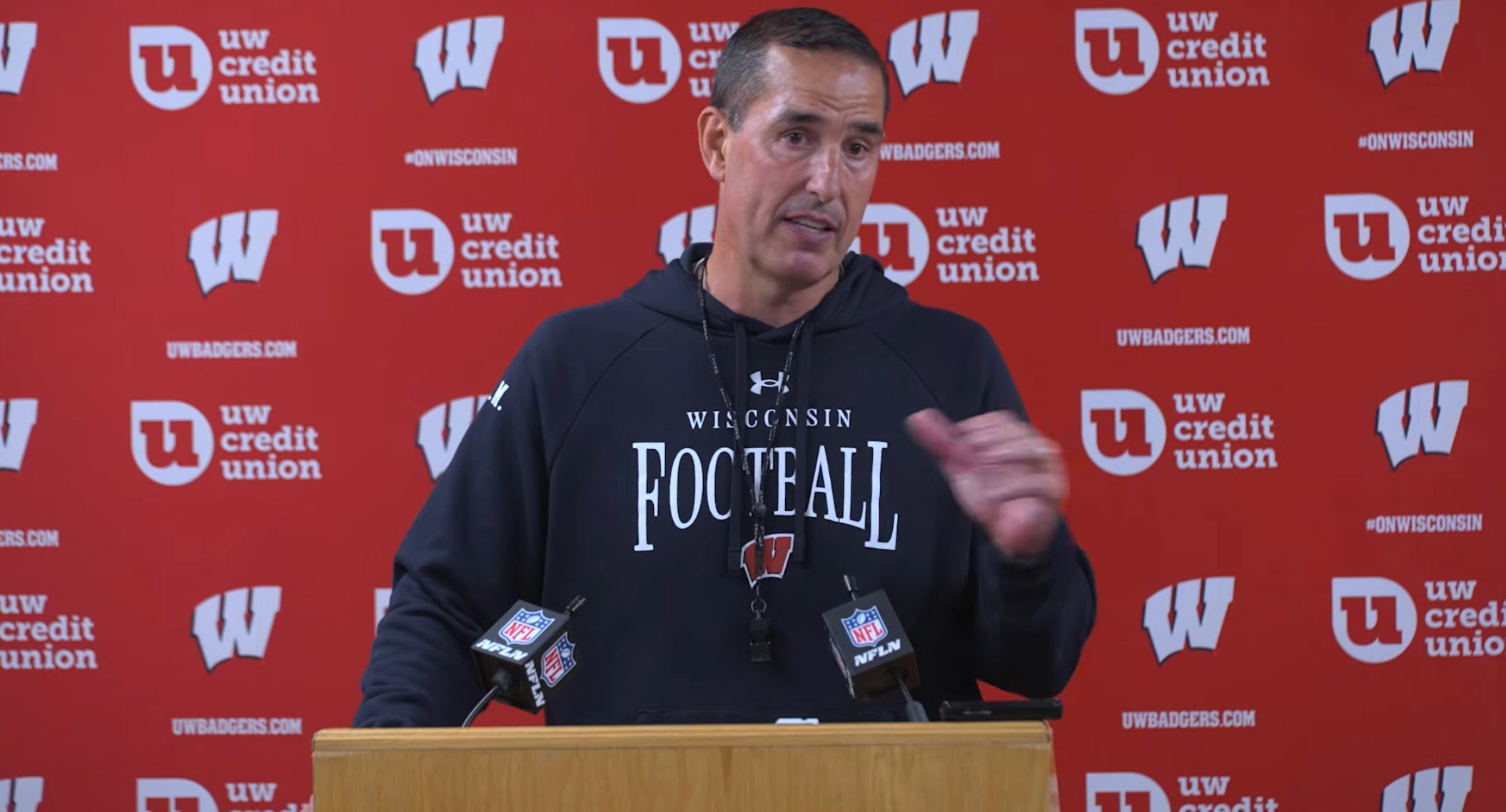
Here are three takeaways from Fickell’s postgame media availability.
Notre Dame exposed Wisconsin in the second half
Fickell opened his press conference calling Sunday a “tale of two halves.”
That’s probably the simplest way to describe it.
Wisconsin went into halftime within a field goal despite an early fumble on a kickoff return by Harrison Bortolotti that handed Notre Dame possession at the Badgers’ 13-yard line. The defense held the Irish to 1.8 yards per carry in the first half, and Wisconsin had actually outgained Notre Dame 143-135.
Then Notre Dame imposed itself.
“I don’t have a great explanation for the second half,” Fickell said postgame. “I give them a lot of credit. I thought that we kind of held the energy and created a lot of momentum in the first half. In the second half, we could do none. They physically got after us. We felt like we were in a really good place in the first half. In the second half, the energy and momentum shifted in one direction, and we could never get it back.”
Notre Dame opened the third quarter with a nine-play, 70-yard touchdown drive. On Wisconsin’s next possession, Joseph threw an interception that D.J. McKinney returned 55 yards for a touchdown.
A 13-10 game had become 27-10 in a matter of minutes.
Fickell acknowledged the two giveaways were “catastrophic,” but his concern extended beyond just those two mistakes. Notre Dame began finding more success on the ground, CJ Carr consistently took the easy throws Wisconsin gave him, and the Badgers’ tackling deteriorated.
“We missed a lot of tackles in the second half,” Fickell said. “And I think that’s probably as big an issue as anything.”
That’s the part Wisconsin can’t simply dismiss as losing to a more talented team.
“I’m not making excuses,” Fickell said. “It’s a really, really good football team. They played really, really well. There’s no doubt, but we have a greater expectation for just the way we execute some things and the way we play physically.”
For one half, Wisconsin looked capable of meeting that expectation. Then, stop me if you’ve heard this before, it couldn’t sustain it for 60 minutes.
Fickell saw enough from Colton Joseph to remain encouraged
The final numbers don’t tell a particularly bad story for Joseph.
In his Wisconsin debut, the Old Dominion transfer completed 19-of-30 passes for 217 yards and a touchdown. But his lone interception became one of the game’s defining plays when it was returned 55 yards for a score.
Fickell wasn’t interested in burying his quarterback for it.
“I love what I saw from him in body language, demeanor, and poise,” Fickell said. “Can he make some more plays? Hell yeah. Are there some things out there that we got to get better at? There’s no doubt.”
Fickell pointed to possible timing and pressure issues on the interception and acknowledged there will be plenty to clean up. What seemed to matter more to him afterward was Joseph’s response.
“I did see something in his eyes,” Fickell said. “I seen a competitive spirit. I seen a guy that threw a pick six that really didn’t, like, look like he was completely down on himself.”
That’s a relatively small thing coming out of a 28-point loss, but it’s also part of what Wisconsin needed to learn Sunday.
Joseph was making his first start for the Badgers, facing one of the best defenses on Wisconsin’s schedule, and doing it at Lambeau Field. There were mistakes, but there were also flashes. He spread the ball around, with Coleman catching four passes for 76 yards and a touchdown, while Tyrell Henry added four catches for 42 yards, Chris Brooks Jr. had three for 38, and Eugene Hilton Jr. caught three for 31.
Fickell came away believing there’s something to build around.
Fickell believes Wisconsin’s season really begins with how it responds
Wisconsin spent the entire offseason talking about finding out what it had.
Thirty-plus newcomers. A ton of new starters. A rebuilt roster and an opening matchup against one of the best teams in the country.
Fickell got his first answer Sunday. Now he believes the more important one is coming.
“The season really begins now,” Fickell said. “That doesn’t mean we weren’t preparing for this game or that the whole fall camp wasn’t about this game. But the season begins for us when we get punched in the face, because now we get to really find out who we are and what we’re about.
“Now we get to figure out who we really are. There’s nothing like adversity. There’s nothing like getting punched in the face and seeing your brothers and how they respond. We’re going to find out a hell of a lot about ourselves really, really quick.”
That connects directly to something Fickell talked about throughout the offseason: identity.
Wisconsin wanted to become a more physical football team. It wanted to establish the run, play complementary football, and develop the kind of leadership capable of responding when games turn against it.
Notre Dame exposed how much work remains.
Wisconsin rushed for only 67 yards. The defense couldn’t get off the field consistently in the second half. The Badgers committed two turnovers that Notre Dame turned into 14 points, and the Irish scored touchdowns on all three of their offensive possessions in the second half.
Fickell isn’t treating those failures as proof Wisconsin can’t become the team he believes it can be. He is treating them as the first real test of whether it will.
“Everybody asks about what’s your identity,” Fickell said. “Well, you know what? You create an identity through a season. And this was one step in a journey that didn’t come out the right way.”
Wisconsin doesn’t have much choice but to move forward. Western Illinois comes to Camp Randall next Saturday, followed by Eastern Michigan at home before the Badgers begin Big Ten play at Penn State.
For all the offseason talk about different energy, increased investment, and a rebuilt roster, Wisconsin is 0-1. What happens from here will tell considerably more about whether any of it actually mattered.
We appreciate you taking the time to read our work at BadgerNotes.com. Your support means the world to us and has helped us become a leading independent source for Wisconsin Badgers coverage.
You can also follow Site Publisher Dillon Graff at @DillonGraff on X.
ND is up 21 with less than two minutes remaining in the game and they throw a touchdown? The game was over and they were trying to score. I haven’t read any thing about running up the score. But Freeman’s play calling doesn’t earn my respect.